What are the top 5 social media platforms?
The top five social media platforms in 2026 are Facebook, YouTube, WhatsApp, Instagram, and TikTok. Marketers use this list to build media plans, treating these networks as stable utilities. But the legal and behavioral foundations of these platforms are cracking under their own scale. You will learn why the 'Big 5' dominate not just by size, but by specific audience intent, and how to differentiate your strategy between legacy engagement traps and emerging privacy-first alternatives.
The major social media platforms are simultaneously the most effective reach engines and the most legally precarious environments for brand safety. This creates a paradox for modern marketers. We cling to the illusion of stability because the user counts are staggering. Facebook remains the world's biggest social media platform with more than 3.1 billion monthly users. TikTok sits at approximately 1.582 billion monthly active users. YouTube commands roughly 2.504 billion. These numbers make the platforms feel invincible.
Invincibility is a dangerous assumption. Recent global legal challenges highlight a structural reckoning. Meta battles legal challenges in the US, Europe and beyond over platform design and its impact on younger users. Analysts compare these trials to the Big Tobacco lawsuits of the 90s. The outcome will likely be analogous. When the underlying ad-tech model faces regulatory dismantling, your media plan collapses with it.
The Meta Monopoly and the Intent Illusion
The big five social networks are not five distinct competitors. They are a fragmented monopoly plus two outliers. Meta Platforms owns four of the biggest social media platforms, all with more than one billion monthly active users each: Facebook, WhatsApp, Messenger, and Instagram. You can verify these baseline metrics on the List of most popular social platforms.
This concentration means diversification across the top five social sites is an illusion of safety. If you spread your budget across Facebook, Instagram, and WhatsApp, you are not diversifying your risk. You are concentrating it within a single corporate infrastructure. When regulatory pressure hits that ad-tech model, your entire strategy fails at once.
To understand why this matters, we have to look at intent. Users do not just "hang out" on these apps. They execute specific behavioral loops.
| Platform | Est. Monthly Active Users (2026) | Primary User Intent |
|---|---|---|
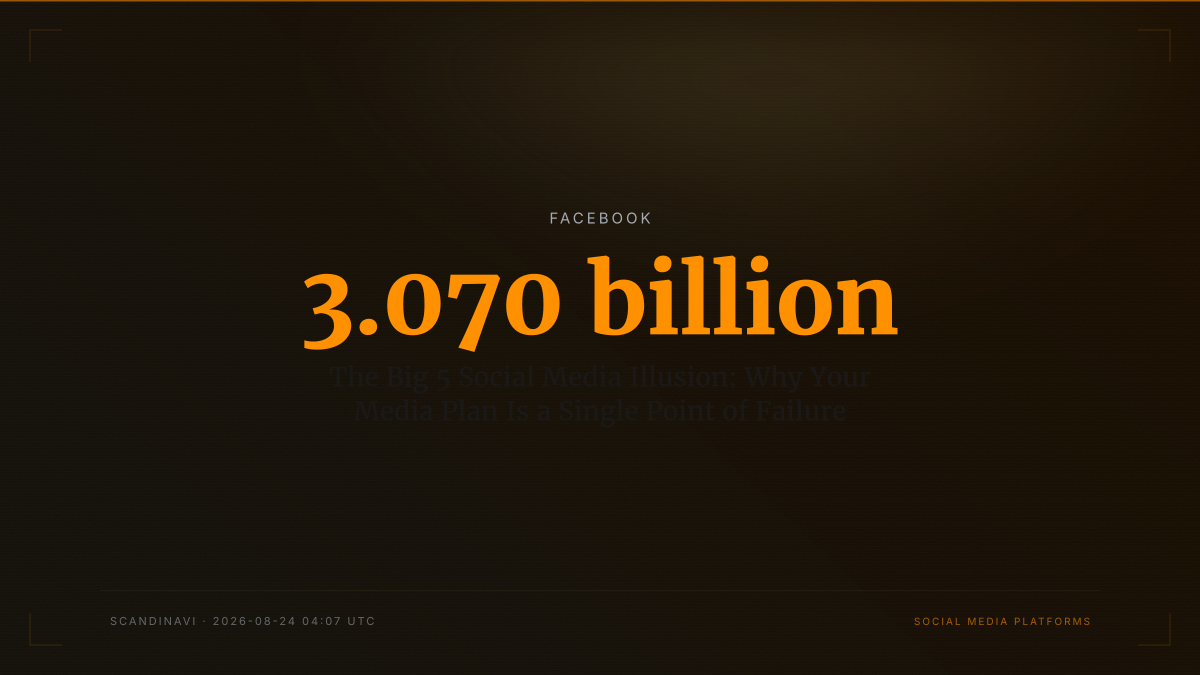
| 3.070 billion | Connect and share | |
| YouTube | 2.504 billion | Watch and search |
| >1 billion | Private messaging | |
| >1 billion | Visual discovery | |
| TikTok | 1.582 billion | Short-form entertainment |
YouTube operates as a search engine. Users arrive with a specific query and expect a long-form answer. Instagram operates as a visual discovery engine. Users arrive to be inspired by aesthetics and trends. TikTok operates as an algorithmic entertainment feed. Users arrive to be passively amused. Facebook operates as a legacy connection tool. Users arrive to maintain existing social ties. WhatsApp operates as a private utility. Users arrive to communicate directly.
When you buy ads, you are buying access to these specific loops. But because Meta owns four of the five top spots, you are essentially buying into one massive behavioral targeting machine. The financial stakes are immense.
"Global social media advertising spend is projected to exceed $268 billion in 2026 , reinforcing how central social platforms have become for customer acquisition and brand growth."— source: 5 Essential Types of Social Media Platforms
That $268 billion is heavily concentrated in the Meta ecosystem. For top social networks marketing, this concentration creates a single point of failure. If the EU or the US forces Meta to dismantle its engagement-driven algorithms, the reach you bought across four different apps vanishes simultaneously.
To protect your strategy, you must audit your intent. Here is a concrete process to separate signal from noise.
- Map your current spend to user intent. Do not just look at cost per click. Categorize every campaign by the primary behavioral loop it targets. Are you paying for search intent (YouTube) or passive entertainment (TikTok)?
- Calculate your Meta dependency ratio. Sum the impressions across Facebook, Instagram, and WhatsApp. Divide by your total social impressions. If this number exceeds 60%, your diversification strategy is a fiction.
- Track intent metrics over vanity metrics. Stop optimizing for likes and views. Measure clicks, saves, and direct shares. These actions indicate actual behavioral engagement rather than frictionless scrolling.
- Identify your privacy-first alternatives. Allocate a small test budget to decentralized or privacy-focused networks. Measure the conversion quality against the legacy platforms.
- Stress-test your legal exposure. Review your brand safety guidelines. If a platform is hit with a major regulatory fine or forced to change its data practices, do you have a fallback channel ready?
Executing this audit reveals the truth about your media plan. You are likely over-indexed on a fragmented monopoly.
What is the least toxic social media platform?
The least toxic social media platform is one built on privacy and data sovereignty, not engagement-driven algorithms. Toxicity in social media is a direct byproduct of design. When a platform optimizes for infinite scroll and variable reward schedules, it amplifies outrage and polarization. The platforms that remove these mechanics naturally reduce toxic behavior.
People often ask what do Gen Z use instead of Facebook. They use TikTok for entertainment, but they are actively migrating to decentralized or privacy-focused alternatives for social connection. Bluesky currently has 41.4 million users. This demographic is fleeing the algorithmic feed in favor of chronological timelines and user-controlled data.
To measure this shift, you need the right instruments. Google Search Console remains the baseline for tracking organic search visibility. Visual Capitalist Data Charts help you visualize macro-level user migrations over time. Statista Social Media Reports provide the granular demographic breakdowns you need to spot emerging challengers.
Moving your audience to a privacy-first environment requires a different content strategy. You cannot rely on algorithmic distribution. You must build for The Human Premium: Why Unscalable Intimacy Is the New Luxury. Authentic connection is now a scarce luxury good. When you publish in a privacy-focused community, your content must stand on its own merit. There is no algorithmic crutch to hide behind.
This shift also impacts how search engines view your brand. Google indexes social media to verify author identity. If you want to build authority in these new environments, you need to understand How to configure an entity mapper for social indexation. Mapping your social profiles correctly ensures that your intent-based content is recognized by search engines, even if the platforms themselves do not prioritize virality.
The transition away from legacy platforms is not just a moral choice. It is a strategic necessity. The The Verification Moat: Why AI Biosecurity Wins in 2026 proves that deterministic, human-verified audit trails are becoming the only way to maintain compliance and trust. Privacy-first platforms offer this verification natively. Legacy platforms are struggling to retrofit it.
How We Hit It: Our Numbers and Scar Tissue
Building an agentic network revealed how much legacy engagement is actually just frictionless addiction. We learned this the hard way.
When we first started building our private AI social network, we tried to mimic the recommendation engines of the major platforms. We thought users wanted the infinite scroll. We built a variable reward schedule into our matching algorithm. It almost broke our server costs. The initial user retention looked fantastic on day one. But the churn rate by day seven was catastrophic. People felt drained. They told us the experience felt manipulative.
We reversed the architecture entirely. We stripped out the algorithmic feed. We replaced it with intent-based matching. Users explicitly state what they want to achieve, and the system connects them with relevant agents or humans. It was much harder to build. The initial engagement numbers dropped. But the retention stabilized. Users stayed because they were getting actual value, not because they were trapped in a dopamine loop. This experience directly informed our thesis on The Post-Addiction Pivot: Why Social Media Is Becoming Boring on Purpose. The attention economy is collapsing under legal liability. Platforms are being forced to abandon addiction models.
We track our own publishing metrics with the same rigor we apply to our product. Consistency matters in a noisy market.
This site has published 46 articles in the last 90 days, demonstrating consistent output in a noisy market. Median time from publish to confirmed Google indexing on this site is 3 days, ensuring timely visibility for topical content. 33% of this site's pages live for at least 14 days are indexed, highlighting the selectivity of search engines even for consistent publishers.
These numbers show that search engines reward sustained, high-intent publishing. They do not reward viral noise. The same principle applies to your social media strategy.
If the 'Big 5' are forced to dismantle their engagement-driven algorithms due to regulation, which platform retains its utility without its addiction engine? YouTube retains its utility because it functions as a search engine. WhatsApp retains its utility because it functions as a private communication tool. Facebook and Instagram will struggle immensely. Their core value proposition is the algorithmic feed. Without it, they are just static directories.
Do not wait for the regulators to force your hand. Run these experiments today.
First, audit your last 10 posts. Calculate the ratio of 'vanity metrics' (likes/views) to 'intent metrics' (clicks/saves/shares). See if you are optimizing for noise or signal. If your vanity ratio is above 80%, your content is failing to drive actual business value.
Second, run a parallel campaign on a niche, privacy-focused community versus a major platform using identical content. Measure true conversion quality versus raw reach. You will likely find that the privacy-focused community yields a lower volume of leads, but a significantly higher close rate.
The future of social networking belongs to intent, not addiction. You can explore our approach to intent-based matching by checking out the About page. If you have questions about how our agentic network operates, the FAQ covers the technical details. When you are ready to move beyond the legacy engagement traps, you can Log in and start building real connections.
HEIMLANDR.io -- Writing at scandinavi.ai