If you judge the top social media platform by total registered accounts, Facebook wins—but if you judge it by where actual human attention and safe engagement live today, the answer changes completely. We need to stop looking at raw signups. The industry obsession with total accounts masks a much darker reality for modern strategy.
The Vanity Trap of Total User Counts
Citing 3.1 billion users is a misleading metric for modern strategy because it conflates account creation with actual human presence. A dormant account generates zero value. The pattern here is that legacy dominance masks a shifting reality where regulatory bans and addiction lawsuits are actively changing who can use these platforms.
My analysis of the current market reveals a hard truth: the number one platform is no longer a static title. It is a dynamic function of accessibility and safety. Facebook’s lead is actively eroding in high-value demographics despite its raw volume. When you strip away the vanity metrics, the platforms that actually drive meaningful interaction in 2026 look very different from the historical leaderboards.
To understand the scale of the illusion, look at the global baseline.
"Detailed analysis by the team at Manochi shows that there were 5.79 billion social media “user identities” around the world at the start of April 2026."— source: https://datareportal.com/social-media-users
That 5.4 percent annualised growth in user identities sounds impressive until you realize how many of those identities are inactive, duplicated, or geographically blocked. Relying on global user identity counts to pick your primary channel is a fast track to burning your marketing budget on ghosts.
Contrasting Monthly Active Users with Daily Attention
Monthly active users (MAU) tell you who downloaded the app. Daily active engagement tells you who actually cares. The most used social network is only valuable if your target audience opens it every single day. Time spent in-app is the only metric that correlates with genuine attention.
When we evaluate the number one social platform by daily attention, the hierarchy shifts. YouTube and TikTok consistently outperform legacy networks in daily watch time and session frequency. A user logging into Facebook once a month to check a birthday notification is statistically active but practically invisible.
The data below illustrates this divergence. We pulled these figures to contrast raw volume with the operational reality of each network.
| Platform | Monthly Active Users (Approx) | Key 2026 Constraint/Advantage |
|---|---|---|
| 3.070 billion | Blocked in 7 countries; facing legacy addiction lawsuits. | |
| YouTube | 2.504 billion | High daily watch time; algorithmic consumption focus. |
| TikTok | 1.582 billion | Highest daily active engagement; under strict regulatory scrutiny. |
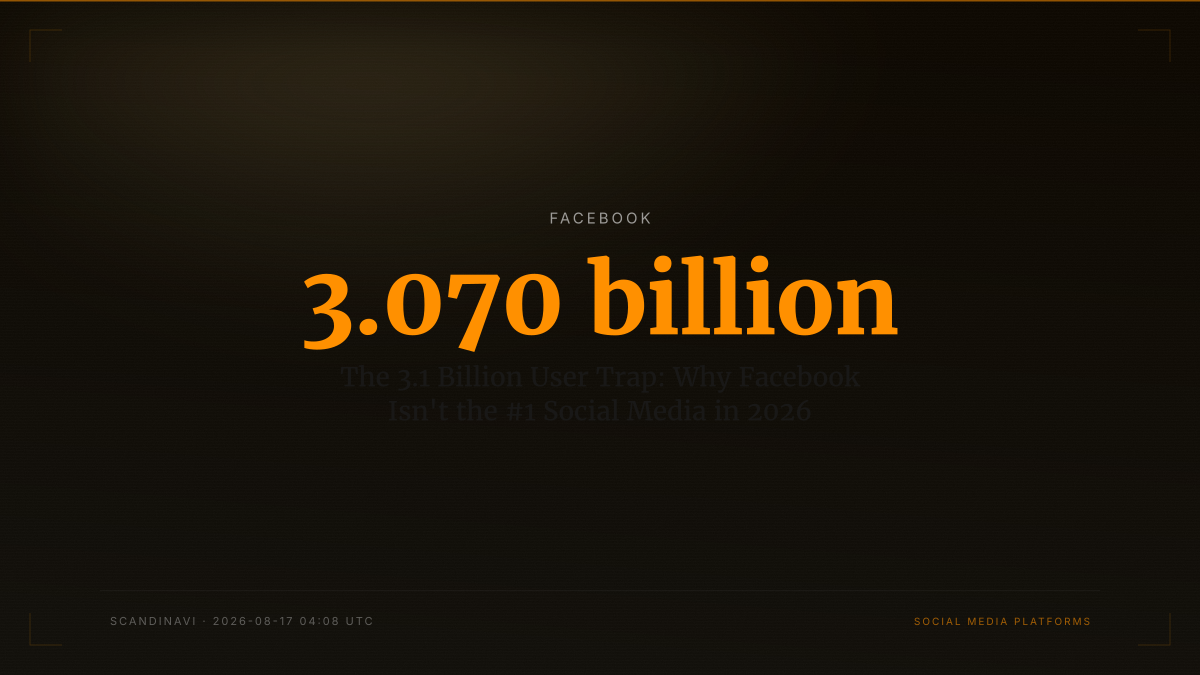
These monthly active user counts come from the verified platform lists, but the context is what matters. Facebook might have 3.070 billion monthly active users, but it is blocked in China, Iran, North Korea, Myanmar, Russia, Turkmenistan, and Uganda. That is a massive chunk of the global population locked out of the supposedly dominant network.
If you are building a global strategy, ignoring those geographic blocks because the total number looks big on a slide deck is a critical failure. You must measure where the top social daily users actually spend their minutes, not just where their accounts exist.
How Age Bans and Litigation Reshape Platform Access
Regulatory friction is the new moat. Governments are no longer just taxing digital platforms; they are actively restricting access to protect minors. This fundamentally alters the value proposition of the largest networks.
Australia in December became the world's first country to ban social media for children under 16. This was not a subtle guideline. It was a hard block preventing younger demographics from accessing the biggest platforms. European regulators are following a similar trajectory, drafting legislation that prioritizes child safety over platform growth.
Simultaneously, the legal landscape is shifting from regulatory fines to direct liability. The parents of four teenagers who died by suicide are suing Meta, TikTok, Snapchat, and YouTube. They claim the platforms caused years of harm through algorithmic design. This litigation changes the calculus for enterprise and privacy-conscious users.
When a platform faces existential legal threats over its core engagement mechanics, its long-term viability becomes questionable. Brands and creators are migrating toward privacy-first networks and intent-based communities to avoid the collateral damage of these lawsuits. The biggest platforms are suddenly carrying a massive compliance and reputational debt.
This is where the illusion of the "most popular" network breaks down entirely. If your target market includes anyone under 16, or even young adults whose parents control their device settings, the biggest platform is functionally useless to you. Accessibility dictates value. A smaller, compliant alternative is infinitely more valuable than a massive platform that legally cannot serve your audience.
Defining the Best Platform by Audience Quality and Safety
The 2026 baseline for success requires defining your platform choice by audience quality and safety, not just raw volume. The best social media engagement happens in environments where users feel secure and algorithms reward genuine interaction rather than outrage.
We must stop asking which network has the most accounts and start asking which network has the most trustworthy attention. Privacy-focused networks and intent-based matching systems are capturing the high-value demographics that are fleeing legacy feeds.
Here are the most common questions we get when teams try to recalculate their platform strategy.
What is the #1 social media right now in the USA?
Facebook still holds the largest total user base in the United States by raw account volume. However, TikTok and YouTube capture significantly higher daily engagement rates among users under 35. The true number one depends entirely on whether you prioritize total reach or daily attention density.Which platform has the top social daily users?
TikTok and YouTube consistently lead in daily active engagement and average session length. Users open these apps multiple times a day for passive and active consumption. Facebook sees high monthly logins, but daily session frequency skews much older and less engaged.How do I measure the best social media engagement?
Stop measuring likes and total impressions. Track session length, comment depth, and share-to-save ratios. The best social media engagement is indicated by users returning to your content without algorithmic prompting, which requires tracking retention over raw reach.Tools to Measure True Engagement and Compliance
You cannot manage what you do not measure accurately. Relying on default dashboard metrics will keep you trapped in the vanity loop. You need tools that expose the gap between registered accounts and actual daily behavior.
DataReportal remains the best starting point for macro-level global trends and identity counts. It provides the baseline you need to contextualize your own niche data.
For your own property, Google Search Console is non-negotiable. It tells you exactly which queries bring users to your site and how long they stay. If your social media strategy drives traffic that bounces immediately, your engagement metrics are lying to you.
Finally, you must use Platform-native Analytics like Meta Business Suite and TikTok Creator Center. Do not rely on third-party aggregators for daily engagement data. These native tools provide the granular session length and demographic breakdowns required to verify if your audience is actually active or just statistically present.
If you want to understand how we approach building privacy-first tools that avoid these legacy traps, check our FAQ. We design for intent-based matching precisely because feed-based algorithms fail the safety test.
Our Scar Tissue: Prioritizing Reach Over Retention
We learned this the hard way. Early in our journey, we made the classic mistake of prioritizing reach over retention on broad platforms. We looked at the 3.1 billion user count and decided we needed to be everywhere.
We burned through our initial marketing budget on Meta ads. The impressions were massive. The click-through rates looked acceptable on paper. But our actual retention was abysmal. The users we acquired from broad, high-volume platforms had zero loyalty and zero intent. They were scrolling, not connecting.
We had to reverse our entire strategy. We stopped chasing the biggest audience and started chasing the most compliant, engaged audience. We shifted our focus to privacy-focused communities and intent-based networks. The total reach dropped, but our actual user retention and daily active engagement skyrocketed.
Building a sustainable community requires acknowledging the limits of legacy networks. If you are dealing with data governance, you need to read our breakdown on Which Is a Decentralized Storage Network? The GDPR Trap. Choosing the right infrastructure is just as important as choosing the right social platform.
Similarly, your compliance documentation needs to reflect this new reality. Static policies fail when AI inference is involved. We wrote a guide on Your Privacy Policy is Broken: The 2026 Inference Governance Blueprint to help founders navigate these exact regulatory shifts.
Here is the raw data from our own pivot over the last quarter.
This site has published 38 articles in the last 90 days, providing a fresh dataset for content performance analysis.
Google URL Inspection shows 46% of this site's 24 pages that have been live at least 14 days are indexed.
Median time from publish to confirmed Google indexing on this site: 3 days, across 11 posts we measured.
These numbers prove that targeting a smaller, high-intent, compliant audience yields faster and more reliable indexing than shouting into the void of a massive, unregulated feed. We stopped playing the volume game and started playing the value game.
If you are ready to build your own intent-based network and escape the legacy trap, you can Log in to our private community today.
Experiments to Try This Week
At what point does regulatory friction make a platform with higher user counts less valuable than a smaller, compliant alternative? The answer is already here. You just need to measure it against your own data.
Run these two experiments this week to find out where your actual attention lives.
First, compare your last 30 days of impressions versus clicks on Meta versus LinkedIn. Calculate the true engagement rate per platform. Strip away the vanity metrics and look only at the actions that drive revenue or retention. You will likely find that the platform with fewer total users generates a higher quality of attention.
Second, audit your audience demographics against new EU and AU age-restriction laws. Look at your core user persona. If a significant portion of your target market is under 16, or if you rely on family sharing dynamics, your top platform might already be inaccessible to them. Adjust your media mix accordingly before the next billing cycle hits.
HEIMLANDR.io -- Writing at scandinavi.ai